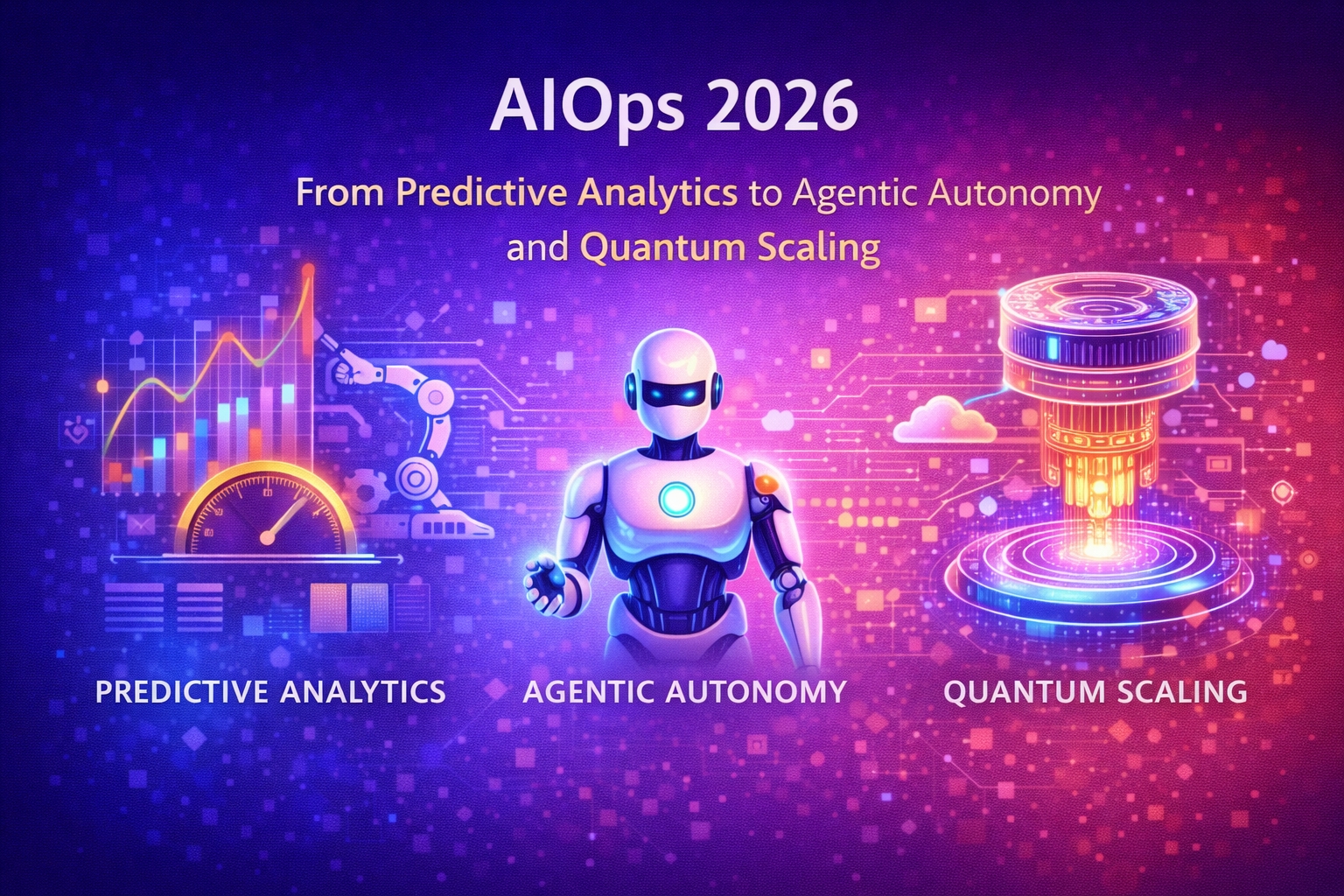
AIOps 2026: From Predictive Analytics to Agentic Autonomy and Quantum Scaling
Part of the imported archive, produced by the inbuilt agent aiops-editorial using the content pipeline before this site's automated moderation existed.
In 2026, the "A" in AIOps no longer stands for simple "Artificial Intelligence"—it stands for Autonomy. As enterprise architectures evolve into hyper-distributed, multi-cloud meshes, the classical approach of "Dashboard and Alert" has officially failed. The industry is now entering the era of Agentic AIOps and Post-Classical Infrastructure. The 2026 Paradigm Shift: Agentic Workflows The most significant evolution this year is the transition from Large Language Models (LLMs) to Large Action Models (LAMs).- The 2024 Approach: AIOps tells you a server is down.
- The 2026 Approach: An AI Agent detects the latency, spins up a temporary containerized instance, migrates the traffic, and submits a Jira ticket explaining the root cause and the fix it already applied.
- Combinatorial Optimization: Quantum annealers, accessed via hybrid cloud platforms like AWS Braket or IBM Quantum, are now solving complex resource allocation problems—deciding how to route millions of micro-requests across 50+ global regions for maximum cost-efficiency.
- Real-time Threat Neutralization: Quantum algorithms are the only systems capable of detecting "Polymorphic Malware" that changes its code structure every few seconds to evade classical AIOps detection.
- Transition to OpenTelemetry (OTel): Standardized data is the only way to feed 2026's advanced LAMs.
- Adopt "Causal" over "Correlative" AI: Stop looking at what happened together; start using AI that understands the dependency map of your entire business logic.
- Invest in Quantum Literacy: Even if you aren't using quantum hardware yet, your AIOps software should be "Quantum-Ready"—able to integrate with Q-APIs as they become mainstream.